GARDEN. GRASSHOPPERS AND MANTIDS
 Egyptian grasshopper (Anacridium aegyptium) Present in most of Europe, Near East and North Africa. Widespread over Cyprus, found all year round in gardens, scrubland and orchards, feeding from leaves. Favors the hot Summers and mild Winters of the Mediterranean climate. More commonn in the lowlands, fleabane being its favorite plant to settle on. One of the larger of the grasshopper species it is identifiable by the vertical black ad white stripes down its eyes. A solitary species it is virtually silent, not singing as other grasshoppers. Although a strong flyer,it will usually jump away from any disturbance using its strong back legs. One of the larger grasshopper species, males are smaller than the female. Males sit on the females back during mating. Females lay eggs in the Autumn singly on the ground, covering them with a frothy secretion which hardens into an egg pod surviving underground over the winter. Eggs hatch in Spring as a worm shaped larva from which the nymph emerges to wriggle to the surface. It sheds its skin (cuticle) in a series of 4-10 molts, wings developing with each molt, to reach adulthood after 4 -10 months. The nymphs are light green changing to brown through successive molts. The adult grasshopper has a lifecycle of one year.
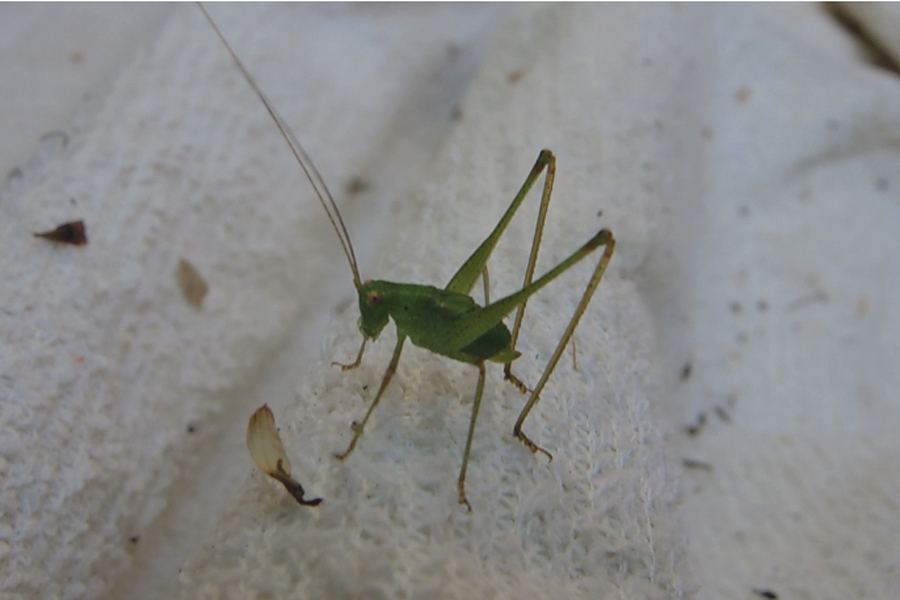 Syrian long-legged bush cricket (Acrometopa Syriaca) Found in South Eastern Europe and the Middle East. Feeds from plants. Has no wings so relies on its powerful hindlegs to leap from plant to plant.
 Egyptian grasshopper (Anacridium aegyptium) juvenile
 Giant African mantis (Sphodromantis virides) juvenile green
 Giant African mantis (Sphodromantis virides) Often found in gardens, around houses and restaurants, attracted by the flies in turn attracted by food waste. Enjoys the higher temperatures of the coasts and plains. Seldom found in ther cooler temperatures in the mountains. Its color varies from bright green to dark brown.
 Mantis (Empusa Fasciata) It has evolved to become a successful predator of fast flying insects, bees and flies. Its yellow green striped body effective camouflage in dry bushes and grasses, its ability to rotate its head and its versatile and powerful forelegs able to stretch out 90 degrees sideways without moving the rest of its body. They will sit on flowers waiting for nectar gathering honeybees. Good flyers, the males fly at night seeking out females, using their long feathered antennae to locate females by their scent, the pheremones they emit. They avoid predators, particularly bats, with their ability to discern high frequency sounds (50-100 khz), detected by a single ear on its abdomen. Humans can only detect sound between 20 hz and 20khz. Females lay their eggs in Spring on grasses. The male dies soon after mating. The nymphs hatch in July, and then overwinter in a pre adult stage, reaching adulthood, after a series of molts, in May.
 Giant African mantis (Sphodromantis virides) juvenile brown.
 Giant African mantis (Sphodromantis virides) adult brown.