
Honeybee
Although most bees nest in wood or crevices in the ground, the honeybee nests in a hive constructed by the worker bees. Eggs laid by the dominant female, the queen, are tended by other females. The eggs develop into larvae, usually white and grub like. Male worker bees then bring back pollen to the hive to feed them. Inside the hive a waggle dance performed by the worker bees tells others the location of the best sites for gathering pollen.
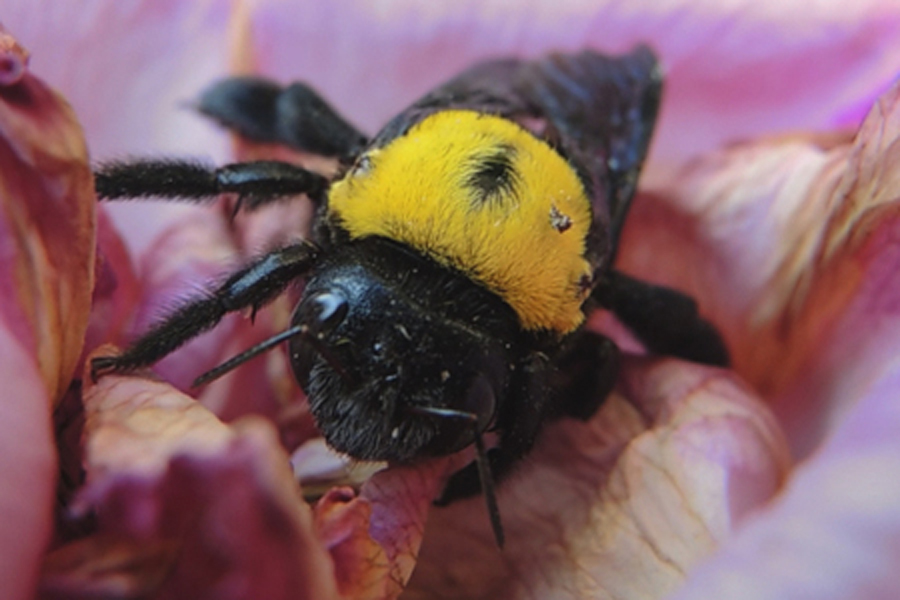
Carpenter bee
The carpenter bee are solitary. They don't live in colonies like the honeybees. They favor forests and gardens where there is a supply of softwood, into which they bore the tunnels where they spend most of their lives. With the warmer Spring weather, males and females emerge from their tunnels to mate. The female will return to an old tunnel, or excavate a new one, a round hole extending several inches into the wood. She constructs a series of cells inside the tunnel, placing a ball of pollen and nectar in each cell, food for the larvae. She lays an egg on each cell, filling the tunnel with 6-8 eggs, sealing off each cell with chewed wood pulp. The eggs hatch after a few days, and the larva go through several molts as they grow, eating the pollen and nectar mixture left by their mother. By late Summer the larvae have finished the food, and start to pupate, transforming into adult bees. They remain in a dormant state in their tunnels overwinter to emerge in the Spring, to mate, and repeat the cycle.

Blowfly Chrysomya albiceps(Calliphoridae)
Feeds from nectar of flowers and decaying meat. Important contributor to the biodegradation of dead animals. Can smell carrion ten miles away.
Lays its eggs in the carcass of dead animals, developing from egg to adult in about 66 days.

Blowfly Stomorhina lunata (Rhinidae)?
Common in southern Europe and Meditteranean.
Larvae grow in egg pods of locusts and grasshoppers.
Migratory. Seen from July to October often feeding from nectar of umbellifer flowers like the hawkbit and cow parsley. .

Potter wasp (Eumenes sp)
A solitary species responsible alone for building its nest, laying its eggs and feeding its larvae. It builds its cells from mud gathered from ponds or puddles. Brings butterfly and beetle larvae to the cells in the nest before sealing the nest. Inside the nest the eggs hang from a silk thread, and when hatched are nurtured by the stored insect larvae. Fully grown the adult wasp chews its way out of the nest.

Oriental Hornet (Vespa orientalis)
A social wasp. Like bees they work together in a group, some responsible for catching prey, others feeding insects to the larvae, with the queen responsible at the head of the group, for laying the eggs. Common in Cyprus. Feeds from other insects, caterpillars and flies. Nest is built underground in Spring from wood fibre moistened in pools of water to make it pliable. The nest is a collection of cells, with larvae hanging from the top of each cell. The worker wasps feed the larvae with dissected insects, with only the nutritious body fed to the larvae.

Bumblebee
Males seen in the autumn, females through the year. The queen rests underground through the winter, emerging in early Spring to build her nest and lay her eggs, fed and cared for by worker bees in the colony. Larger and rounder than the honeybee, their bodies are covered in soft hair. With this added insulation they are able to live in colder conditions and at higher altitudes. Beating their wings at 200 time a second, they fly at up to 54 km/h and travel 1-2 kilometers to find food, returning to the same flower patch everyday. They choose the flowers by detecting their temperature and sensing their electrical fields. They then leave a scent mark behind to recognise a nectar rich flower when they return and to deter other bees from feeding. They feed on plant nectar but with longer tongues than the honey bee, are able to feed from deeper in the flower head, reaching nectar from plants other bees cannot reach. They have no sense of hearing but are sensitive to vibrations carried through surfaces.